


From proof of concept to production
Every engagement follows the same path. We prove the work on your own documents, run it in your environment with the people who will use it, then take it live with a team that stays on after launch. At the end of each stage, you decide whether to continue.
Three stages, each ending in a decision
Start small and widen the scope only when the last stage has shown results. Work from each stage carries into the next, so nothing is rebuilt along the way.
Proof of concept
Two weeks
Pilot
One month
Production
One to two months to go-live
After go-live
Ongoing
Some teams go from the proof of concept straight to production. More often, a pilot comes first.
What happens at each stage
Each stage has a clear purpose, a short list of what we need from you and a sign-off that decides the next step.
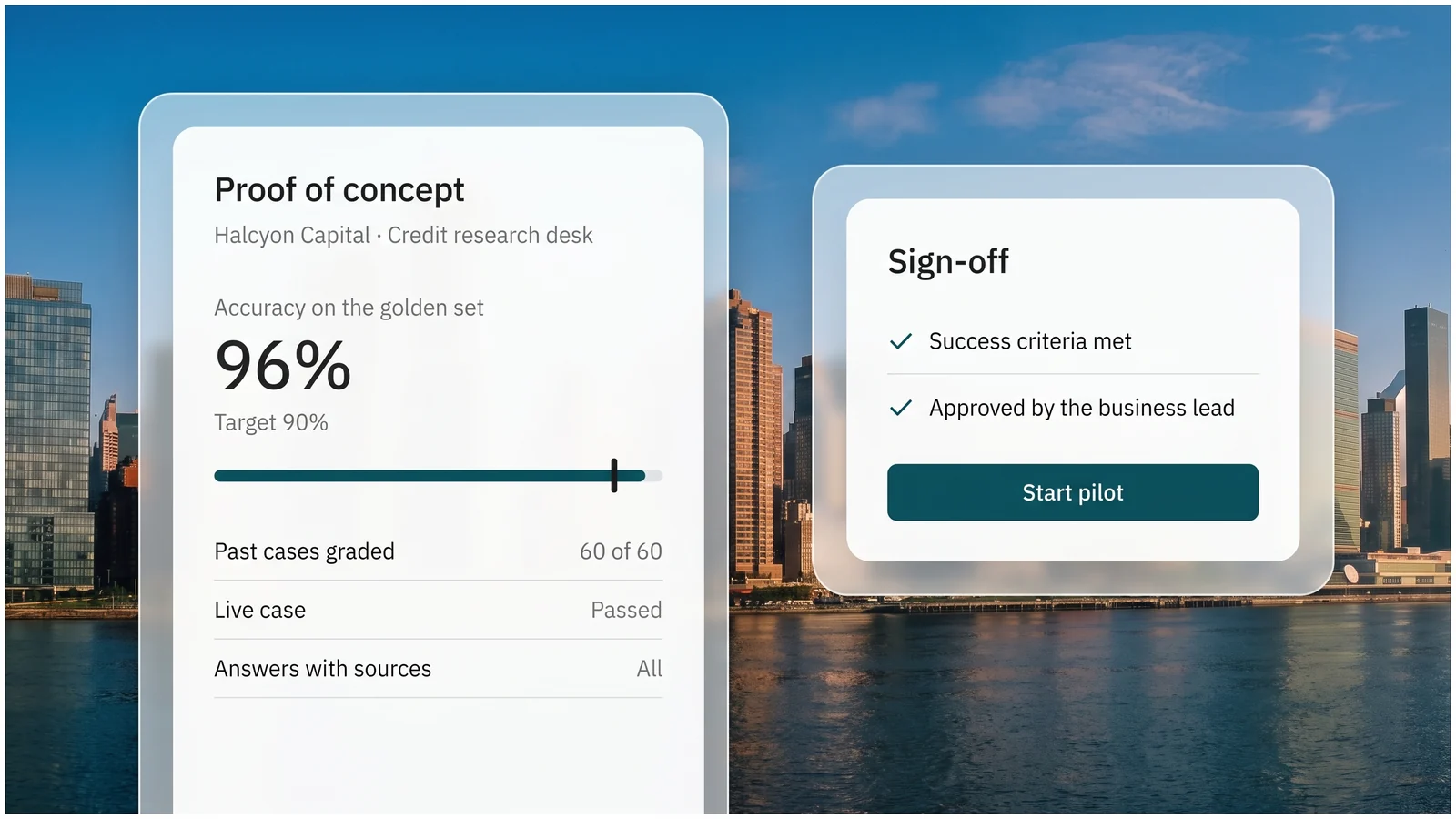
Proof of concept
Prove it on your own work, in two weeks.
- What happens
- We grade relevance and accuracy against a golden set of your past work, first on past cases where the right answer is known, then on a live one.
- What we need
- Sample documents, a few finished examples and the questions your team really asks. For AI Due Diligence, two or three past deals with their final memos.
- Ends with
- Your sign-off against the success criteria agreed on day one.
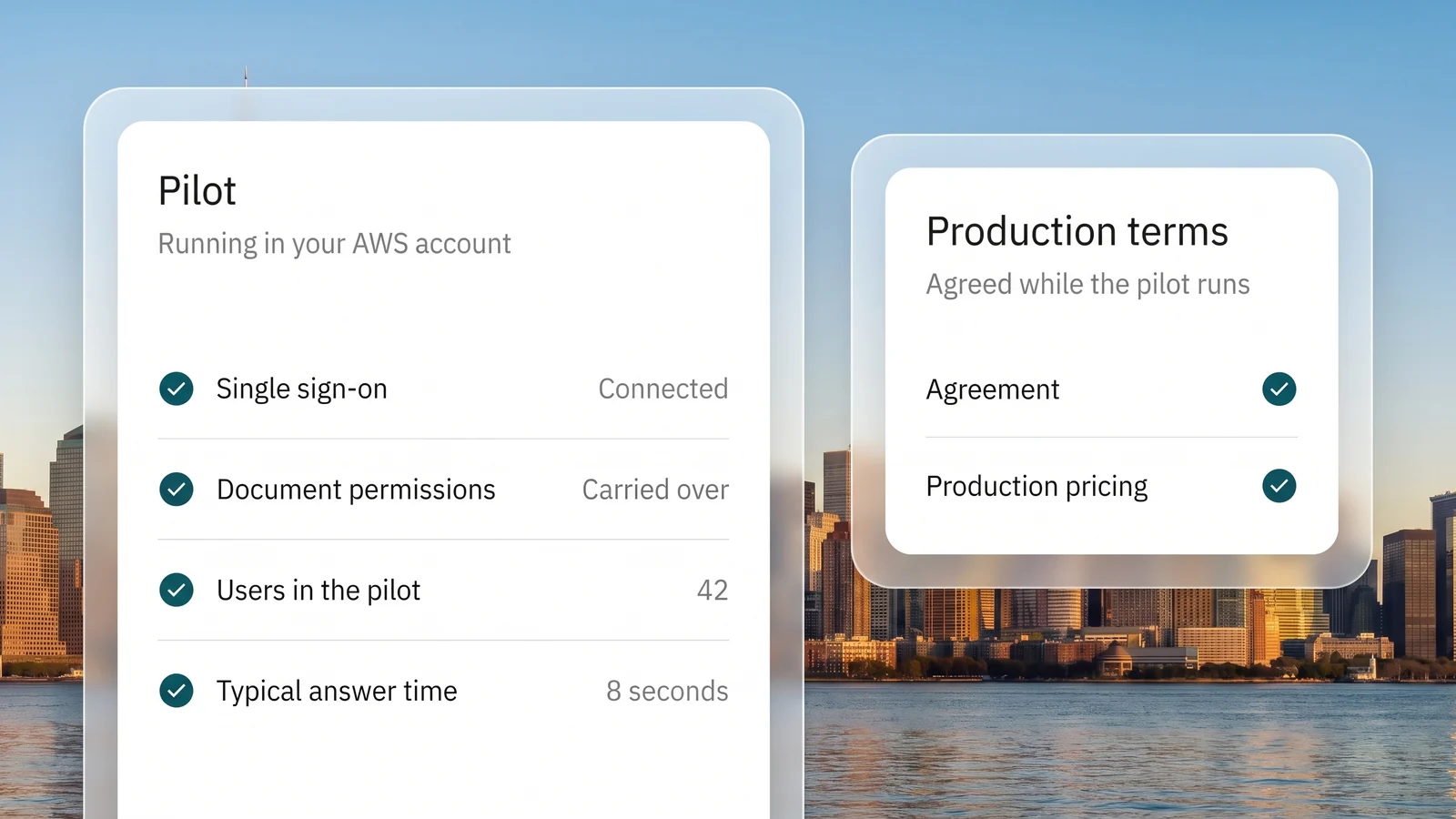
Pilot
Run it in your environment for one month.
- What happens
- The people who will use it work with it under real conditions: speed, sign-in, permissions and volumes. Production terms are agreed alongside.
- What we need
- Access to your cloud account, single sign-on and a first group of users.
- Ends with
- A go-live decision from your users and your business lead.
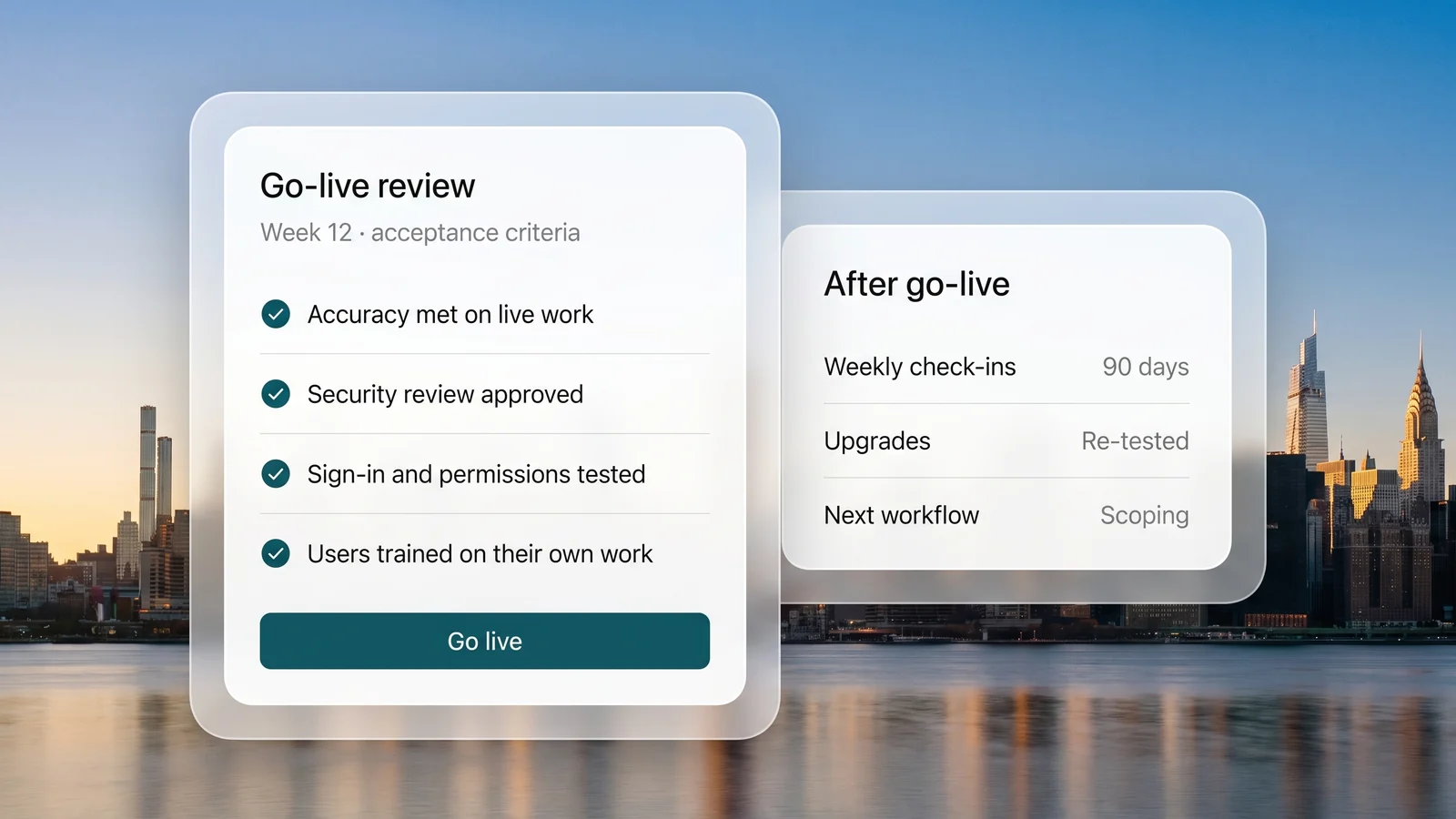
Production
Go live in one to two months and keep it accurate.
- What happens
- Seven phases from scoping to training, then about 90 days of weekly check-ins as real use starts.
- What we need
- Time from your experts in review sessions, and testing by your first users.
- Ends with
- Sign-off against your acceptance criteria, then a steady run.
What each stage proves
Each stage tests more of what matters before you commit to the next. By go-live, everything on this list has been shown on your own work.
- Tested at this stage
- Carried forward
| Proof of concept2 of 7 | Pilot5 of 7 | Production7 of 7 | |
|---|---|---|---|
| Accurate on your past work | |||
| Accurate on live work | |||
| Fast at real volumes | |||
| Sign-in and document permissions | |||
| Tested by the people who will use it | |||
| Users trained, runbook handed over | |||
| Support and upgrades in place | |||
| Decided by | Your business lead | Your users and business lead | Your acceptance criteria |
The road to go-live
Production runs in seven phases, several of them side by side. Pick a solution to see its typical plan, and select a phase to see what happens and who is involved.
7 weeks from kick-off to go-live
What happens
Workshops with the deal team on your investment committee memo, the asset classes and deal types you cover and what a good first pass looks like. Two or three recent deals with their final memos become the golden set, and your IT and security review starts.
From
Solutions lead, forward-deployed engineer
From your team
Deal team lead, IT contact
Where
In person for the kick-off workshops, or by video
Weeks are counted from kick-off. When a pilot has run in your environment, its setup carries over. Your security review starts in week one and runs alongside the build. Approvals on your side are the most common reason a date moves, which is why we start them first.
Who is involved, phase by phase
A named team on our side from the first workshop to the last check-in, and a small group on yours whose time goes mostly into workshops, reviews and testing.
| Discovery | Environment | Integration | Tuning | Acceptance | Training | Hypercare | |
|---|---|---|---|---|---|---|---|
| From | |||||||
| Solutions leadOwns the scope, the plan and each sign-off | |||||||
| Forward-deployed engineerLearns how your team works and tunes the solution | |||||||
| ML engineerMeasures it against your golden set | |||||||
| Integration and platform engineersConnect sources, sign-in and permissions | |||||||
| DevOps engineerBuilds, secures and monitors the environment | |||||||
| Customer successRuns training, check-ins and account reviews | |||||||
| From your team | |||||||
| Business leadSets the goals and signs off each stage | |||||||
| Subject-matter expertsShare past work and review outputs | |||||||
| IT contactGrants access and sets up sign-in | |||||||
| Security teamReviews the deployment and approves it | |||||||
| First usersTest it on real work before go-live | |||||||
| AdminsRun it day to day after handover | |||||||
What keeps it on schedule
The work that usually slows an AI project down is started early or run in parallel.
Success criteria on day one
A golden set of your past work and an accuracy target are agreed before the proof of concept starts. Every later release is re-tested against them.
Security review from week one
We share our SOC 2 Type II report and ISO 27001 certificate under NDA and work through your questionnaires while the build runs.
Tested environments
Every deployment starts from the same tested setup, in the Needl.ai cloud, a dedicated instance or your own AWS or Azure account.
Nothing rebuilt between stages
What the proof of concept proved is what the pilot runs, and the pilot's setup carries into production.
Contracts in parallel
The agreement and production pricing are settled while the pilot runs, so going live does not wait on paperwork.
A focus on adoption
Regular check-ins with your users after go-live. Use grows when the solution keeps improving on their feedback.
After go-live
The team that built it stays on. Most of the work after launch goes into improving what is live and adding the next workflow to the same environment.
One client's first ten months
A marketing analytics platform went live 8 weeks after kick-off, then shipped release after release on the same environment.
- Month 0A knowledge assistant inside the platform's own app
- Month 1Answers from the platform's dashboard data
- Month 6Automated reports for the platform's clients
- Month 7Power BI data, and answers from inside Claude
- Month 8Answers in each client's own metric names
- Month 9Report drafting from inside Claude
- Month 10New client workspaces set up without our help
The first 90 days
Weekly check-ins, fixes and tuning as real use starts.
Steady run
Monitoring and regular upgrades, each re-tested against your golden set before it reaches your team.
New models
When a better model arrives, or your provider retires one, we test the change on your golden set and move you across.
Changes on your side
A new drive, a new source or a larger library is handled under your support agreement.
What clients have seen
- 8 weeksFrom kick-off to go-live for a marketing analytics platform's assistant, in its own AWS account.
- About 4 weeksFor each later workflow on the same environment to reach testing.
- 3 solutionsTwo report workflows and a research assistant for a credit rating agency, all on one dedicated instance.
“Needl.ai has gone above and beyond in delivering value. We are already interested in expanding its scope across the company.”
Frequently asked questions
What teams ask before they start.
How long does a proof of concept take?
Two weeks. We begin with past cases where the right answer is known, then run on a live one, graded against the success criteria we agree with you at the start.
What do you need from us for a proof of concept?
A use case, a few examples of finished work, the documents behind them and the questions your team really asks. For AI Due Diligence, that means two or three past deals with their final memos. The proof of concept runs in the Needl.ai cloud, under our SOC 2 Type II and ISO 27001 controls.
Do we need a pilot?
Not always. Some teams go from the proof of concept straight to production. Many run a one-month pilot in their own environment first, to check speed, sign-in and real volumes with the people who will use it.
How long until we are live?
One to two months from kick-off: about a month for a knowledge assistant, about six weeks for market intelligence, and closer to two months for AI Due Diligence and report automation, where the memo or report format is tuned against your team's own past work. Security review and approvals on your side run alongside the build and are the most common reason a date moves, so we start them in week one.
Can it run in our own cloud?
Yes. Pilots and production run in your own AWS or Azure account, in a dedicated instance that we operate, or in the Needl.ai cloud. Trust & Security sets out the controls in each.
What happens when a new model comes out?
We test it on your golden set and move you across when it does better. You can also use OpenAI, Anthropic or Google models through your own account, and your workflows stay the same when the model changes.
Who supports it after launch?
The team that built it. About 90 days of weekly check-ins follow every go-live, then monitoring, regular upgrades and account reviews, with new use cases added to the same environment.
How is it priced?
The proof of concept is scoped with you before it starts, including its success criteria and any cost. Production pricing and the agreement are settled while the pilot runs. Support, upgrades and model changes are covered by an annual agreement, and new features are scoped separately.

Start with one workflow
Tell us the work you want to prove first. We will come back with a plan for the proof of concept: the success criteria, the data we need and the dates.
Review deployment and security